1.0 The United Electronics Coating Association (UECA)
The leading companies providing protective coatings for the electronics industry, used throughout all world economies, have formed a new collaborative approach to their futures by the formation of the new association. The new organization has global scope and covers all chemical-based protective coatings technologies.
2.0 Protective Electronic Coatings
Protective coatings, often referred to as conformal coatings, provide electrical insulation for electronics and their components against a range of potential harmful conditions: moisture, aggressive solvents, chemical and gaseous environments etc. Their use as an essential part of the manufacture of electronics provides multiple advantages to the consumer or industrial customers, as well as contributing to several environmental and sustainability objectives.
3.0 Association objectives
The founding members of the UECA have agreed to work together, to develop technical and market solutions to further the environmental and sustainability goals globally for all electronic products. By identifying the relevant regulations covering chemicals, and those covering the circular economy, reusability and recycling of electronic products, the association will guide the membership in the development of the appropriate product solutions.
Three working groups have been established to take these objectives forward:
- Regulations and legislation – collating the current and planned future state of regulations and legislation covering the coatings industry and the related electronics sector. Once a full picture of the future regulatory environment is achieved, this group will consider how best to assist regulators around the world to achieve these, primarily, environmental objectives and timescales. Decisions on future lobbying of different administrations and / or regulatory entities will be taken by members at appropriate times.
- Marketing and policy – Taking the Regulatory objectives towards reality – whilst emphasizing the role of sustainable and responsible coating technologies. Initially the group will collate publicly available information and guidance on the role of coating solutions to further recycling, extension of product life and reuse of electronic products. Further projects and dissemination activities will be decided on by the group members.
- Standards – agreeing the standards impacting the range of coating technologies and organizing appropriate industry representation on the relevant world and regional standards bodies. These representatives will develop new or amended standards in cooperation with the other 2 working groups.
Each working group’s activities are managed by the association management group, with representation from each member at senior level. Any future expansion of activities and shift in policy objectives will be decided by this group.
4.0 The future of the electronic industry and the vital role of protective coatings
The use of all electronics and in particular specialist technologies has been increasing across the world for several years – it is predicted that these markets will continue to expand very rapidly over the next 10 years. There are several factors which leads to these conclusions:
- The expansion of smart and connected devices and systems across all world markets.
- The Internet of Things (IoT) market continues to expand as devices and “things” become even more interconnected to create a smarter, more autonomous environment for users. It is estimated that 55.7 billion connected IoT devices will be in the market by 2025 (IDC).
- Aided by the public launch of the much-anticipated interoperability protocol, Matter, in late 2022, consumer spending on smart home related devices worldwide is projected to grow 137% from 2020 in 2027 at $204 Billion (Statista).
- IoT is not just for consumers but has established a strong hold in the industrial sector. The global industrial internet of things market size was $263.52 billion in 2021 and is expected to expand at a compound annual growth rate (CAGR) of 23.1% from 2022 to 2030 (Grand View Research).
- Though seeming ubiquitous, phones and other connected products continue to grow. The number of mobile devices is expected to reach 18.22 billion by 2025, an increase of 4.2 billion devices compared to 2020 levels. (Statista)
- The use of technology solutions to meet environment and climate change alleviation objectives.
- The transformation of the world’s vehicle market to a primarily electric future will increase the market for power electronics. It is estimated that the power electronics for electric vehicle market size was valued at $2.59 billion (about $8 per person in the US) in 2018, and is projected to reach $30.01 billion (about $92 per person in the US) by 2026, growing at a CAGR of 35.5% from 2019 to 2026 (Allied Market Research).
- Refurbishing and renewing existing electronic products not only reduces landfill waste but opens technology ownership for emerging markets. For example, the demand for global refurbished and used mobile phones was valued at approximately $52.34 billion in 2021 and is expected to reach a value of around $146.43 billion by 2030, at a CAGR of about 11.45% during the forecast period 2022 to 2030. (Source: Custom Market Insights). India’s refurbished smartphone market alone is expected to reach $10B by 2026 (Business Standard).
- Manufacturers and brands are successfully reutilizing and recycling materials and components to cut down on raw material usage. Nearly 20 percent of all material used in Apple products in 2021 was recycled, the highest-ever use of recycled content (Apple), while Samsung has reused over 276,000 tons of recycled plastics globally in products since 2009 and is on track to double that number by 2030 (Samsung).
- Technological solutions for sustainability are not just limited to the revitalization of existing products. Experts expect to see a 40% increase in solar power installations between 2023 and 2027 (SEIA). Since 2010, more than half of all new wind power was added outside the traditional markets of Europe and North America, driven by the continuing boom in China and India. In 2015, China installed close to half the world’s added wind power capacity (BP).
These significant market expansions will be linked to an enormous increase in electronic waste, with linked environmental impacts. Policies to limit, if not reduce, this waste are already major policy objectives of Governments and Regulators worldwide. Protective coatings can play a key role in supporting the reduction of electronic waste through product life extension.
The role of the protective coating industry in meeting these objectives for the whole electronics industry cannot be understated. As electronics are increasingly used in vital systems and end use technologies, including military, critical transport, and electrical grids, the use of appropriate coating solutions will be increasingly vital to bolster reliability.
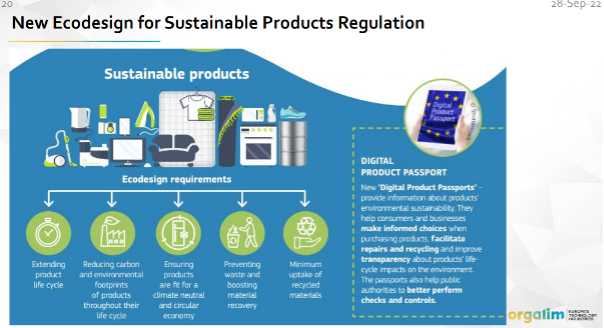
To meet the wider environmental aims outlined, these coating technologies need to allow and facilitate the recycling, extended life, and reuse of the end use technologies. This can all be summarized as part of the circular economy principles, or in Europe, part of the future Eco-design plans. The summary of these positions for Europe can be summarized below. (thanks to ORGALIM for this image). Although these plans only cover the member states of the European Union, the principles are highly likely to be copied or adopted in other world markets.
5.0 The future role of the UECA
The founding members of the association believe that membership should be open to any company placing protective coating solutions on any world markets and stipulate that they agree with the principles for the industry’s future outlined in this paper. For any new or amended product standards to be developed, or lobbying of administrations, the highest proportion of the world industry needs to be involved – and ideally be active members of the UECA.
Annex
A The Circular economy
The circular economy is an alternative means of economic system designed to not only be sustainable, but tackle global challenges including climate change, biodiversity loss, waste, and pollution (
Source). This is achieved by abandoning the traditional, non-sustainable, linear model of “take, make, dispose” adopted by most of today’s modern economy.
By adopting the circular economy for electronics production, products and devices go from the “dispose” phase mentioned above to being reused or repurposed in multiple ways including:
- New products using more recycled and recyclable content
- By designing and making electronic products from recycled materials, and ensuring they are designed to be recycled again at the end of their life, disposal can be avoided, and repurposing of materials is embraced to make better, more modern products.
- Products and their components are in service longer
- Designing electrical products and their components for longevity, coupled with robust options of reuse (including repair, resale, refurbish, and remanufacture), can keep products in use for longer and help delay waste flows.
- End-of-use products are collected and recycled to a high standard
- Products no longer suitable for use or reuse are collected, sorted, and recycled using responsible practices and standards supporting climate action, fair labor and a just transition. Lease models can be adopted by manufacturers to reclaim the outdated products from consumers to have them disassembled and built into newer models.
- (Source)
B Recycling
Recycling consists of converting waste into reusable material. This material can then be reused in a cyclical model of manufacturing instead of the traditional linear model of “take, make, dispose.” Electronic waste, or e-waste is now the world’s fastest growing waste stream, estimated to hit 81.6 million tons by 2030 (
World Economic Forum).
Electronic recycling, or e-waste recycling, is possible today. Disassembly and processing of finite materials found in electronics including precious metals, plastics, and more, can be reused and repurposed for future products and applications.
C Extended life of electronic products
With close to 50 million tons of electronic waste produced every year across the world (
Nature), finding a means to curb this amount as it grows is critical. One choice is simply to extend the life of electronic products. Electronic devices lifespan can be protracted by:
- Durable materials, durable design
- Many devices can last much longer if they are simply designed to do so. Products are sometimes manufactured to fail at a fraction of their lifetime to ensure upgrading through a new purchase by a consumer. This capital focused approach is bad for the environment and bad for the end user. By designing products with more robust materials, and mechanical designs, a product can last its intended lifetime, saving the end user money.
- Right to Repair
- As electronic products follow a trend of smaller, lighter, faster, their ability to be repaired becomes harder, riskier, and more expensive for end users. Many today are calling for a “right to repair” the products they have purchased by either themselves or a certified repair company. When manufacturers and brands design products with repair in mind, they are enabling a much longer life for the device and delaying the creation of e-waste.
D Re-use of products
The saying, “one man’s trash is another man’s treasure” certainly applies to electronic products. In the continuing cycle of technological upgrades, these ‘outdated,’ yet fully functioning products, can and are being reutilized in the refurbishment market.
Once viewed as a lesser priority, companies are now seeing new opportunities for reselling refurbished products including entirely new markets. For example, sales of refurbished smartphones in 2021 grew three times faster than the sales of new phones, with Apple owning 40% of the used market (
Source). One way this is profitable to Apple and other companies is through services. Popular reoccurring revenue streams including music, storage, email, and more, are typically paid for on a per device basis. More products mean more revenue, regardless of the age or state of the device.